Generic Tables
Lakekeeper's Generic Table API catalogs non-Iceberg tables — Lance, CSV, Parquet, or any other format — alongside Iceberg tables in the same Warehouse. Each generic table sits in a Namespace, has a name, a format string, an optional base location, schema, statistics, properties, and a free-form doc field. Engines handle writes against the underlying format; Lakekeeper handles identity, governance, access control, and lifecycle.
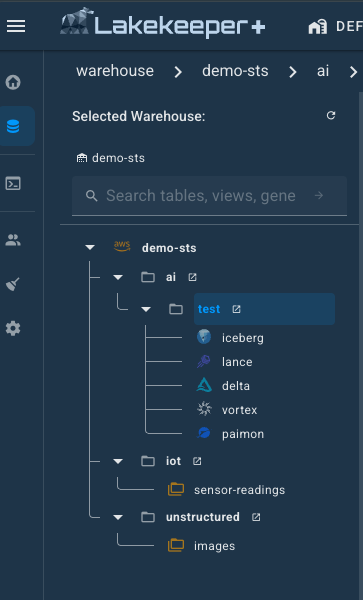
Unlike Iceberg tables, Lakekeeper does not commit format-specific metadata for generic tables — readers and writers go directly to the storage location after obtaining catalog metadata and credentials. This makes the API format-agnostic: any future or experimental format works without changes to the catalog.
When to use generic tables
- Raw landing zones — register CSV, JSON, or Parquet drops so they show up in the same catalog and inherit the same permissions as downstream Iceberg tables.
- Lance for multimodal AI — store text, image embeddings, raw bytes, and scalar features in one table, then run vector + SQL queries via LanceDB, DuckDB, or Polars. See the example below.
- Experimental formats — prototype new file/table formats behind the same
/credentials, soft-delete, and authorization plumbing as production Iceberg tables.
Capabilities
Generic tables are first-class citizens. Most of Lakekeeper's table-side machinery applies:
| Feature | Generic tables | Notes |
|---|---|---|
| Credentials vending (S3, GCS, Azure) |  |
GET /lakekeeper/v1/{prefix}/namespaces/{ns}/generic-tables/{t}/credentials |
| Remote signing (S3) | |
For S3 storages without STS. See below |
| Soft-deletion + undrop | |
Respects per-warehouse soft-delete settings |
| Protection flag | |
protected: bool on load response; toggle via GET/POST /management/v1/warehouse/{wh}/generic-table/{id}/protection. Drops require force=true when set. |
| Rename | |
POST /lakekeeper/v1/{prefix}/generic-tables/rename |
| Listing + pagination | |
Same cursor scheme as Iceberg tables |
| Per-action permissions | |
16 distinct actions (drop, undrop, read_data, write_data, get_metadata, rename, change_ownership, grant-* relations, ...) |
| Case-insensitive identifiers | |
Cross-engine name resolution applies |
| Name uniqueness across types | |
A generic table cannot collide with an Iceberg table or view in the same Namespace |
| Stored schema / statistics fields | |
Free-form JSON; informational only |
| Format-agnostic | |
format is an opaque string |
| Commit coordination |  |
The catalog does not arbitrate writes — engines write directly |
| Schema enforcement | |
Schema is stored, not validated against data files |
Working with generic tables
The flow is the same for every format: create the table, load it with vended credentials, then read or write directly with the format's own library. Lakekeeper only brokers metadata and short-lived storage credentials — never the data itself — so the same credentials path works for any format and only the reader library changes.
You don't need to hand-roll these HTTP calls:
- Python — the Python client (
pylakekeeper) wraps create/load/list/drop and maps vended credentials into the keys Lance,boto3, andfsspecexpect. See its Lance example. - PySpark — Apache Spark reads and writes generic tables through the same vending flow.
- Java / Flink — Apache Flink shows the same vending flow.
For a runnable end-to-end example (warehouse setup, STS credentials, create/load/drop, undrop, listing), see tests/integration-tests/lance/test_lance.py.
Remote signing (S3 without STS)
Vended credentials need an STS endpoint. Some S3-compatible storages (for example Scaleway, or OVH) don't offer one. Then remote signing is the only way to grant access, and it works for generic tables exactly as it does for Iceberg tables.
Nothing extra needs to be configured on the table: as long as the warehouse's S3 storage profile has remote-signing-enabled set to true, the load and credentials responses of a generic table carry the signing properties in their config:
| Property | Meaning |
|---|---|
s3.remote-signing-enabled |
true — the client should sign through Lakekeeper |
signer.uri (and legacy s3.signer.uri) |
Base URI of the sign endpoint |
signer.endpoint (and legacy s3.signer.endpoint) |
Path of the sign endpoint for this generic table, v1/signer/{warehouse-id}/tabular-id/{generic-table-id}/v1/aws/s3/sign |
As with Iceberg tables, whether signing or vended credentials is offered depends on the X-Iceberg-Access-Delegation header and the storage profile — see Disabling Credential Vending and Remote Signing. Request remote-signing explicitly if your client supports both and the storage has no STS.
The client then sends each S3 request it wants to make to that endpoint and receives the Authorization headers back. Lakekeeper authorizes every signing request against the generic table's own permissions:
GET/HEADrequireread_dataon the generic tablePUT/POST/DELETErequirewrite_dataon the generic table
Only requests whose URI lies within the generic table's base-location are signed; anything else is rejected. Views are never signable.
Client-side support varies. PySpark and Java engines use the properties above automatically. Format libraries that talk to S3 through their own client (Lance, for example) generally expect static credentials and do not implement the Iceberg signer protocol, so for those, prefer a storage that supports STS-vended credentials.
In the Console
The Lakekeeper Console lists generic tables alongside Iceberg tables and views inside each Namespace, tagged with their format so you can tell them apart at a glance. Selecting one opens a detail view with its location, schema, statistics, properties, and the same actions (rename, protect, drop/undrop, permissions) available for Iceberg tables.
Because the format field is an opaque string, any format shows up as a first-class entry — below are a few common ones.
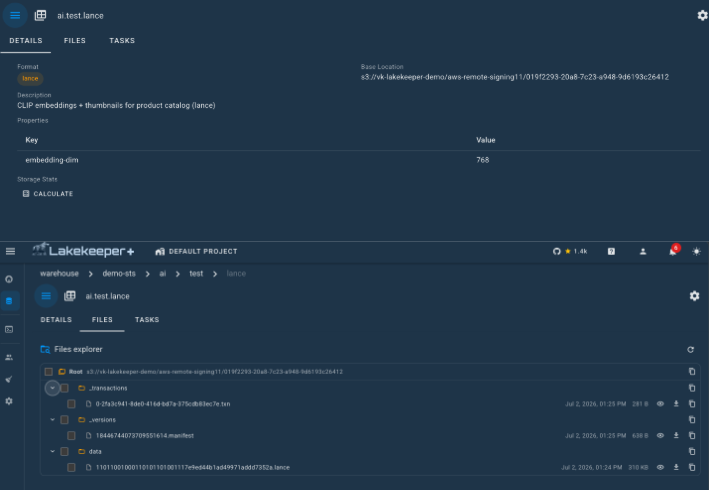
Lance
Multimodal / vector tables written with Lance. The detail view surfaces the stored schema (embeddings, scalar features, raw bytes) and the storage location engines read from.
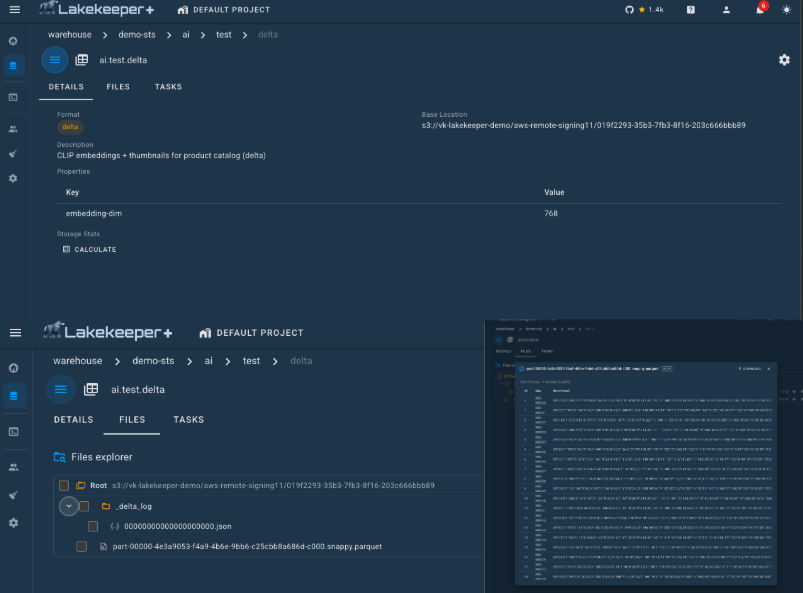
Delta
Delta Lake tables cataloged as generic tables — governed and permissioned in Lakekeeper while engines read/write the Delta log directly at the table location.
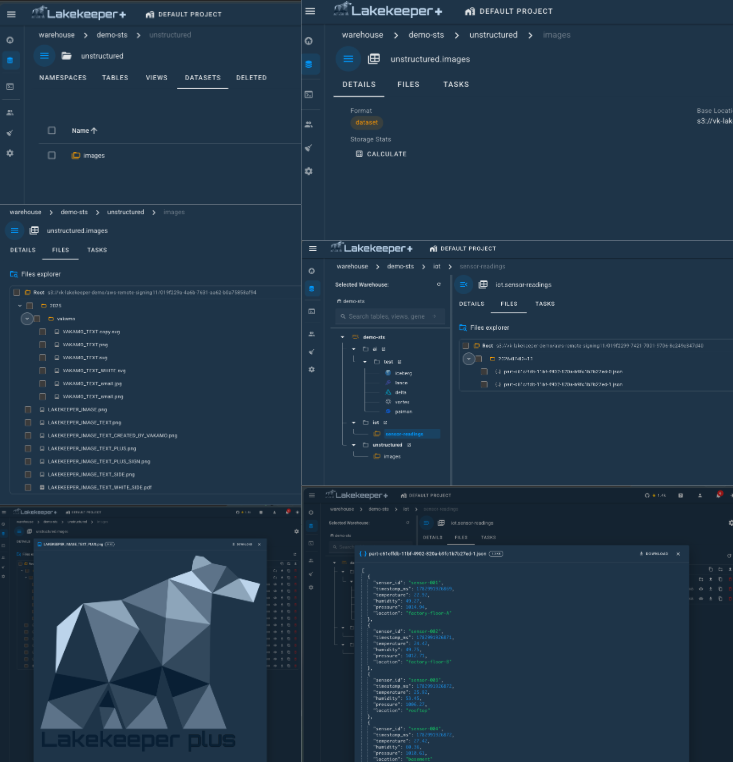
Dataset
A raw dataset (CSV / JSON / Parquet drop) registered so it appears in the catalog and inherits the surrounding Namespace's permissions.
Authorization model
Generic tables have an OpenFGA object type (lakekeeper_generic_table) parallel to lakekeeper_table and lakekeeper_view. Permissions inherit from the parent Namespace and Warehouse, and can be granted to users or roles through the Grants API. See Authorization for how the model resolves them.
Because grants are per-action, you can — for example — give an ML platform service read_data and get_metadata on every generic table in a namespace without granting drop or change_ownership.
Limits
- The catalog does not coordinate concurrent writes. If your format requires commit coordination, the engine or the format library is responsible.
- Schema and statistics fields are informational. Engines that need an authoritative schema should read it from the underlying files.
- Generic tables and Iceberg tables share the namespace's identifier space — a name conflict across types is rejected at create time.